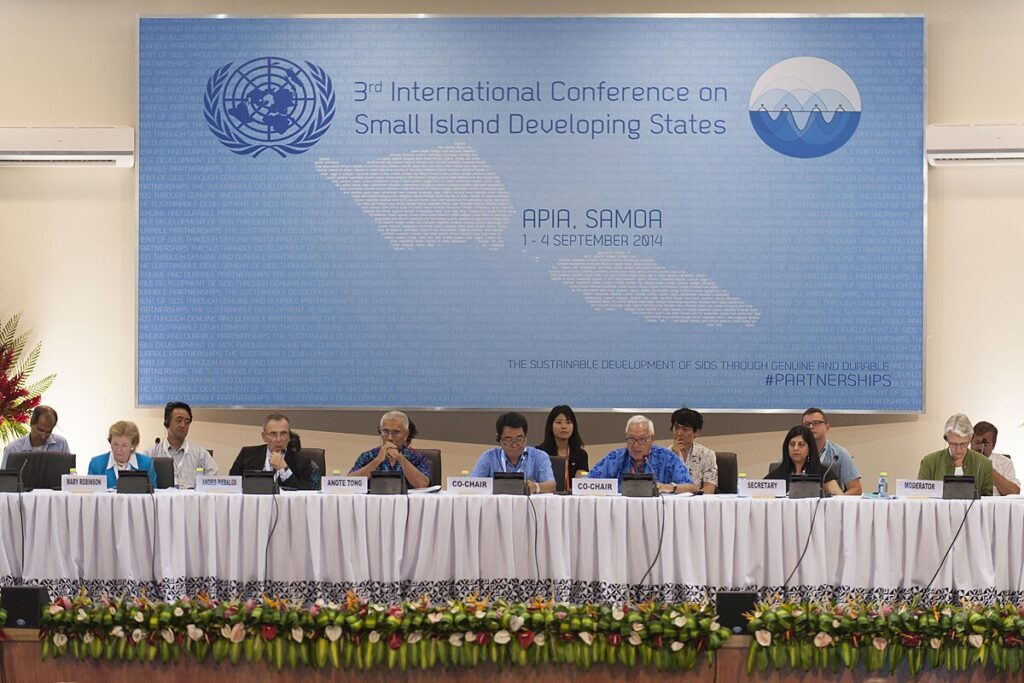
The earliest formal designation of Small Island Developing States (SIDS) as a distinct group of developing countries with their own set of specific challenges occurred in 1992 at the UN Conference on Environment and Development in Rio de Janeiro, Brazil, which is commonly referred to as the Earth Summit. There, the UN recognized the sustainable development challenges facing SIDS and the need to implement programs and measures to support them. Preceding the conference, small island states established the Alliance of Small Island States (AOSIS). Comprising nearly 20% of UN membership, the AOSIS provides SIDS a platform to pursue collective goals. They used this entity to lobby for the first UN conference devoted exclusively to SIDS in 1994 in Barbados with the Global Conference on the Sustainable Development of Small Island Developing States. Since then, the UN has continued to focus attention on these countries as a “special case for sustainable development in view of their unique and particular vulnerabilities,” with its most recent conference on SIDS taking place on May 2024 on St. John’s, Antigua and Barbuda.
The UN recognizes 57 countries as SIDS: 39 are UN Members, and 18 are non-UN Members or Associate Members of Regional Commissions. SIDS are grouped in three geographical regions: the Caribbean, the Pacific, and the Atlantic, Indian Ocean, and South China Sea (AIS). Each of these regions has bodies to which the respective SIDS may belong: the Caribbean Community (CARICOM), the Pacific Islands Forum (PIF), and the Indian Ocean Commission (IOC).
There are 39 UN Members that are SIDS, and 18 non-UN Members or Associate Members of the Regional Commissions that are SIDS. Although the UN uses the designation, it has no formal definition of SIDS. The closest the UN has come to a definition is describing the characteristics shared by the 39 SIDS that are UN Members:
“Small Island Developing States share very high levels of intrinsic vulnerabilities, especially to external shocks. The high levels of vulnerability of the natural, economic, and social systems of Small Island Developing States arise from the following characteristics: Small Size; Remoteness; Vulnerability to external (demand and supply-side) shocks; Narrow resource base; and Exposure to global environmental challenges.”
Countries and associate states simply declare themselves as SIDS, engendering great elasticity in the classification. Indeed, three SIDS are not islands: Guinea-Bissau, Guyana, and Suriname. Several associate members are not sovereign states, but rather sub-national island jurisdictions (SNIJs). There is no consensus on the definition of SNIJs, but scholars suggest the following: populated islands with a degree of autonomy in a partnership with a parent state. Aruba, Curaçao, and Sint Maarten, for example, are members of the Kingdom of the Netherlands with limited autonomy. Puerto Rico and the US Virgin Islands—a US commonwealth and a territory, respectively—also have restricted autonomy.
Their numbers make SIDS a lobbying force in the UN and other international fora. As noted, they achieved recognition in a UN Sustainable Development Summit dedicated to SIDS, which has been repeated in subsequent years. Their own inter-governmental organization AOSIS represents the interests of small island and low-lying coastal developing states in negotiations regarding international climate change and sustainable development. The UN declared 2014 as the year of the small island developing state and mandated that the UN High Representative must address the issues of SIDS in the UN agenda. As the SIDS gained prominence focusing on their vulnerabilities, however, some SIDS have sought to shift the focus from their small land size to their large ocean territory.
The Transition to Large Ocean States
A defining feature of nearly all SIDS, of course, is that they are surrounded by water. This presents economic and environmental challenges, but it may also provide SIDS with substantial benefits if they can develop a sustainable ocean-based economy. SIDS have extensive reach over the oceans that surround them—and the resources therein—because of the Exclusive Economic Zone (EEZ) that extends for 200 nautical miles from their coasts.
The EEZ is a concept adopted in 1982 at the Third United Nations Conference on the Law of the Sea, allowing a state full sovereignty over a territorial sea of 12 nautical miles, with an exclusive economic zone of 200 nautical miles beyond a nation’s coastal baseline. Article 56(1) of the 1982 UN Convention of the Law of the Sea (UNCLOS) codified the concept but even states not party to the Convention claim an EEZ of 200 nautical miles pursuant to customary international law. The sovereignty over an EEZ is not absolute, but it is substantial, providing “sovereign rights for the purpose of exploring and exploiting, conserving and managing the natural resources.”
Counting their EEZs, SIDS, on average, have sovereignty rights over ocean space 28 times greater than their land space. They have jurisdiction over nearly 30% of all oceans and seas in marked contrast to occupying less than 1% of the world’s landmass. Ten Pacific SIDS have a landmass of only 23,938 square miles, roughly the size of the state of Florida, but their combined EEZs exceed 15,444,000 square miles, larger than the surface of the moon or the continent of Africa. Viewed yet another way, the combined EEZs of Mauritius at 2.3 million square kilometers and the Seychelles at 1.3 million square kilometers encompass an area larger than India.
The 1982 UNCLOS extended the jurisdiction of SIDS dramatically, but it would be decades before they began identifying as large ocean states (LOS). One of the earliest instances of this shift in self-identification occurred in 2010 when the President of the Marshall Islands told the United Nations General Assembly, “The Marshall Islands is a large ocean State. Our tuna fisheries resources represent the primary pathway to economic development, but the key stocks have been pushed beyond sustainable levels.” In 2012, the Pacific Islands Forum Summit convened under a banner proclaiming “Large Ocean Island States.” The trend continued in 2014, when Anote Tong, President of Kiribati, identified his nation as a “Large Ocean State” in remarks before the UN General Assembly: “While we in Kiribati have been labeled a Small Island Developing State, we are in fact a Large Ocean State spanning an ocean area of 3.5 million square kilometers.”
SIDS moved beyond merely asserting their largeness and implemented their newly claimed status by seeking environmental protection of ocean spaces in their EEZs in marine protected areas (MPAs) and large marine protected areas (LMPAs). An LMPA is an MPA exceeding 100,000 square kilometers. The United States, United Kingdom, France, and Australia, began establishing LMPAs in the 1970s. Several SIDS joined the movement in the 2000s, designating significant portions of their EEZs to the creation of LMPAs . Indeed, in 2017 the Cook Islands designated its entire EEZ as an LMPA, which was the world’s largest MPA at the time: Marea Moana of 1.97 million square kilometers.
The transition of SIDS to LOS is constrained by the UN country classification for SIDS that fails to acknowledge that they depend on the ocean for achieving sustainable development goals. The UN uses SIDS as a country classification for many island nations, determining the level and type of support that is directed to countries with similar development constraints. The SIDS classification criteria, however, derive from the Least Developed Country (LCD) classification developed in the 1970s that focused on terrestrial economic development, such as agriculture, mining, and manufacturing.
The LCD classification preceded the 1982 Law of the Sea Treaty and establishment of EEZs. Thus, the outdated SIDS classification ignores the reality of island nations possessing larger sovereign territory because they subsequently had gained rights to substantial ocean territory through the treaty. A new LOS classification could direct resources in a manner aligned with the needs of island nations that depend substantially on the ocean for economic development. If adopted, such a policy would not only provide more relevant assistance to islands, but it would formally recognize LOS as a category, legitimizing and likely accelerating the shift from SIDS.
The Blue Economy – The Promise
Having flexed their LOS muscles to create LMPAs, SIDS began looking beyond environmental stewardship of their EEZs to the economic development of the resources there. As large ocean states controlling vast marine resources, they contemplated a blue economy with “economic development and ocean health as compatible propositions.” The UN first promoted the concept of the blue economy at the UN Conference on Sustainable Development held in Rio de Janeiro in 2012 (“Rio+20”), emphasizing the opportunity for SIDS. Such promotion was largely the result of efforts by Pacific SIDS in the preparatory phase of Rio+20 as they championed the concept of the blue economy to counter the planned green economy theme of the conference (i.e., reconciling economic growth with environmental protection). They feared the terrestrial bias of the green economy would undermine the interests of SIDS, and they were intent that the conference focus on the oceans and an agenda that would address the needs of SIDS.
The outcomes document of Rio+20 never mentioned the term blue economy, but the subsequent Blue Economy Concept Paper highlighted the term “Blue Economy paradigm” and its importance as a sustainable development framework. Since then, the blue economy has become an integral part of the global discourse on sustainable development of the oceans. The great promise in developing the ocean’s resources has been a driving force behind the shift from SIDS to LOS, thus elevating the concept of the blue economy was an important accelerant in the transformation.
There are several definitions of the blue economy. The UN and World Bank consider the blue economy as generally understood to be a “long-term strategy aimed at supporting sustainable and equitable economic growth through oceans-related sectors and activities.” Debate exists, however, about a more precise definition of the blue economy and what uses of the ocean should be included.
One side contends that no ocean activity should be considered part of the blue economy unless it is “both environmentally sustainable and socially equitable,” such as through wave energy, ecotourism, and responsible fisheries. Others believe that a broader range of activities should be included, such as shipping, ports, and mining. Although it does not define the blue economy, the Commonwealth Blue Charter, signed by 54 nation states, commits the signatories to the development of the oceans consistent with the UN Sustainable Development Goals.
The oceans under the jurisdiction of SIDS can generate revenue from various activities, new and old. Several existing industries rely on the ocean, such as coastal tourism, shipping, offshore energy, and fishing. Collectively, they constitute 3.5-7% of the world’s GDP, and this figure is expected to double by 2030. Globally, oceans generate approximately 31 million jobs, excluding informal and artisanal employment.
Emerging industries also offer potential benefits: seabed mining, aquaculture, marine biotechnology (the use of living marine resources for pharmaceuticals), and offshore renewable energy (wind, wave, and tidal energy). Seabed mining of minerals is an activity of heightened interest as the demand for metals and rare-earth elements increases, but SIDS are divided on whether to permit it in their EEZs. Some Pacific SIDS have banned or paused mining, while the Cook Islands has issued three licenses for mining within its EEZ. Indirect ocean related activities also may play a larger role in the economies of SIDs: coastal development, shipping, and port infrastructure and services.
The desire to tap into the economic benefits of their EEZs has propelled the shift from SIDS to LOS, but how SIDS will reap these benefits is unclear. Several SIDS have institutionalized the blue economy by developing a targeted policy or strategy, sometimes supported by the creation of a dedicated ministry or department. There are 16 countries with some type of ‘institutional arrangement’ that focuses on the blue economy, and 11 of them are SIDS. The institutionalization of the blue economy is a significant policy consequence of the transformation of SIDS to LOS.
The strategies of Mauritius and Seychelles are two examples of such institutionalization efforts. In 2013, Mauritius announced its intention to develop a plan to increase the share of the blue economy to 20% of its GDP in the medium term. The government’s immediate task is to consolidate the existing ocean sectors, such as tourism, seaports, and fishing, with emerging sectors, such as aquaculture, marine biotechnology, and renewable energy. More recently, Mauritius allocated part of its 2025-2026 budget to developing the blue economy.
In 2018, the Government of Seychelles launched the Blue Economy Strategic Framework and Roadmap for a “whole of government” approach to the sustainable development of its ocean resources. The Seychelles are working with The Nature Conservancy and the UN to plan the sustainable development of its 1,374,000 square kilometer EEZ. To finance these plans, Seychelles raised $15 million by issuing the world’s first sovereign Blue Bond—a financial instrument specifically designed to support sustainable marine and fisheries projects. The Seychelles also plan to establish an independent ocean authority to provide for the monitoring and protection of its EEZ.
The Blue Economy – The Problems
A prerequisite of a successful blue economy is the ability of SIDS to deter activities that deplete or endanger the EEZs natural resources. Such activities include unreported fishing, illegal seabed mining, oil spills, and other types of pollution. Illegal, unregulated, and unreported fishing (IUU) is estimated at 26 million tons of fishing globally, accounting for up to $23.5 billion worth of seafood per year. IUU is a threat to SIDS that depend on the fishing industry but also to the world’s food supply.
Not only is the detection of such activities necessary, but a viable enforcement mechanism to stop them is paramount. Even larger countries, such as Argentina, Chile, and Ecuador, have difficulties preventing IUU fishing by Chinese fleets in their EEZs. Surveillance of the EEZ of SIDS will have benefits beyond preventing IUU: it will improve search and rescue capacity, weather forecasting, disaster preparation and response, and the detection of human trafficking, contraband smuggling, and oil spills.
SIDS lack the capacity to undertake these measures comprehensively. They need technology, expertise, and financing. SIDS have sovereign authority over their EEZs, but they are unable to fully exercise it. The field of international relations describes this as a lack of “positive sovereignty.” The inability to fully exercise their jurisdictional rights is a central challenge for SIDS. This gap need not, however, prohibit development of the blue economy. Rather, it presents an opportunity for large, developed countries to collaborate with SIDS by investing in them on a fair and equitable basis to provide the technology, expertise, and capital to make the blue economy a reality.
The path to such collaboration, however, may not be a smooth one. Camillo Gonsalves, Minister of Finance, Economic Planning, Sustainable Development, and Information Technology of St. Vincent and the Grenadines, is a leading proponent of SIDS and their efforts to self-identify as large ocean states, and he has identified a threshold issue: he worries that foreign entities will exploit small islands because of “unequal bargaining positions and grossly inequitable distribution of returns.”
This is a valid concern, of course, and policymakers should promote a more level playing field. One approach is for the UN, World Bank, regional multilateral banks, and non-governmental organizations (NGOs) to provide funding that enables SIDS to obtain technical and legal assistance, supporting them in negotiations with foreign investors. The US Department of State and at least one NGO have employed this model to provide Caribbean SIDS such assistance in their negotiations of renewable energy projects.
SIDS should also seek to ensure the investment is sustainable and safeguards ocean ecosystems. One possible source of support is the World Bank, which assists countries in developing the blue economy in a manner that protects marine and coastal areas. It administers PROBLUE, an umbrella multi-donor trust fund designed to support the implementation of the UN’s Sustainable Development Goal (SDG) 14: “Conserve and sustainably use the oceans, seas and marine resources for sustainable development.”
In this nascent area of investment, guidelines are emerging that may prove useful—to the SIDS as well as to developers, financiers, and investors—in structuring transactions to avoid damaging the EEZ and its resources. The Blue Nature Capital Financing Facility, funded by the Government of Sweden and managed by the International Union for Conservation of Nature, has developed a Positive Impacts Framework for assessing a project’s impact on climate adaptation and mitigation, biodiversity, and sustainable livelihoods. In addition, the World Wildlife Fund has published “Principles for a Sustainable Blue Economy.”
Shifting to a blue economy will require long-term financing at scale. The cost to meet the UN’s SDG 14—to use the oceans for sustainable development by 2030—is estimated to be $174.52 billion per year. Private finance, sovereign blue bonds, and debt for nature swaps are possible sources of funding. Blue bonds and debt swaps have been used to finance the blue economy in Seychelles, but it is premature to know if they can succeed in other SIDS.
Preliminary evidence indicates that investing in the blue economy offers substantial returns. One analysis found that the overall return on investment in the sustainable ocean economy can be five times greater than the costs. This study evaluated potential returns from investments in four key sectors: mangrove conservation and restoration, offshore wind energy, shipping decarbonization, and sustainably sourced ocean-based protein production. In some cases, returns exceed this fivefold multiple; for example, every $1 invested in scaling up offshore wind production could yield up to $17 in returns.
Conclusion
SIDS are promoting a paradigm that flips the traditional view of them as vulnerable small island states to one in which they are large ocean states controlling substantial resources in their EEZs that extend 200 nautical miles from their coastlines. The self-identification by SIDS as LOS is no mere labeling exercise. There is enormous potential for SIDS to exploit the resources of their EEZs, but doing so will not be easy. SIDS have sovereign authority over nearly 30% of all oceans and seas, but they lack the means to fully exercise this authority. The lack of positive sovereignty is a core challenge for SIDS to make the shift to LOS meaningful and the tapping of the blue economy a reality.
References
“About Small Island Developing States,” Office of the High Representative for the Least Developed Countries, Landlocked Developing Countries and Small Island Developing States, accessed November 2025, https://www.un.org/ohrlls/content/about-small-island-developing-states.
Philippe Hein, “Is a Special Treatment of Small Island Developing States Possible?” (UNCTAD/LDC, 2004), https://unctad.org/system/files/official-document/ldc20041_en.pdf.
Max Everest-Phillips, Small, So Simple? Complexity in Small Island Developing States (Singapore: UNDP Global Centre for Public Service Excellence, 2014), https://www.undp.org/sites/g/files/zskgke326/files/publications/GPCSE_Complexity%20in%20Small%20Island.pdf.
United Nations, “4th International Conference on SIDS,” 2024. https://sdgs.un.org/smallislands/about-sids4.
David Tennant, “Debt and Development in SIDS: A Call for Action,” in Debt and Development in Small Island Developing States, ed. Damian King and David F. Tennant (Palgrave Macmillan, 2014), https://doi.org/10.1057/9781137392787.
Siân Herbert, Development Characteristics of Small Island Developing States (Institute of Development Studies and Partner Organisations, 2019), https://gsdrc.org/publications/development-characteristics-of-small-island-developing-states/.
Godfrey Baldacchino, “UNCLOS at 40: Small Island Developing States and New Forays into Positive Sovereignty,” The Round Table 111, no. 5 (2022): 601, https://doi.org/10.1080/00358533.2022.2129635.
Manaswita Konar and Helen Ding, A Sustainable Ocean Economy for 2050: Approximating Its Benefits and Costs (World Resources Institute, 2020): 4-6, https://oceanpanel.org/wp-content/uploads/2022/05/Ocean-Panel_Economic-Analysis_FINAL-1.pdf.
Peter Malanczuk, Akehurst’s Modern Introduction to International Law (Routledge, 1997): 183-184.
Luis Felipe López-Calva, “Finance, Partnerships and Innovation: Large Ocean States Pave the Way to the 2030 Agenda,” United Nations Development Programme, October 12, 2018, https://www.undp.org/blog/finance-partnerships-and-innovation-large-ocean-states-pave-way-2030-agenda.
Flavie Halais, “How Small Islands Can Harness the Ocean Economy,” Devex, July 24, 2019, https://www.devex.com/news/how-small-islands-can-harness-the-ocean-economy-95290.
Alister Doyle, “How Sea-Level Rise Could Affect Pacific Nations’ Fishing Rights,” Christian Science Monitor, March 11, 2021, https://www.csmonitor.com/Environment/2021/0311/How-sea-level-rise-could-affect-Pacific-nations-fishing-rights.
Allen Vosrie Cedras, “Large Ocean Economies: A Post-COVID Narrative for Small Island Developing States,” United Nations Development Programme, August 13, 2020, https://www.mu.undp.org/content/mauritius_and_seychelles/en/home/blog/2020/large-ocean-economies–a-post-covid-narrative-for-small-island-d.html.
Andrew Hume et al., “Towards an Ocean-Based Large Ocean States Country Classification,” Marine Policy 134 (2021): 2, https://doi.org/10.1016/j.marpol.2021.104766.
Nicholas Chan, “Large Ocean States: Sovereignty, Small Islands, and Marine Protected Areas in Global Oceans Governance,” Global Governance: A Review of Multilateralism and International Organizations 24, no. 4 (2018): 538, https://doi.org/10.1163/19426720-02404005.
Anote Tong, “Statement by H.E. President Anote Tong,” 69th UN General Assembly, New York, September 26, 2014, https://www.un.org/en/ga/69/meetings/gadebate/pdf/KI_en.pdf.
World Bank, The Potential of the Blue Economy: Increasing Long-term Benefits of the Sustainable Use of Marine Resources for Small Island Developing States and Coastal Least Developed Countries (World Bank, 2017), https://sustainabledevelopment.un.org/content/documents/2446blueeconomy.pdf.
Ki-Hoon Lee et al., “The Blue Economy and the United Nations’ Sustainable Development Goals: Challenges and Opportunities,” Environment International 137 (2020), 1, https://doi.org/10.1016/j.envint.2020.105528.
Philippa Louey, “The Pacific Blue Economy: An Instrument of Political Maneuver,” Marine Policy 135 (2021): 3-4, https://doi.org/10.1016/j.marpol.2021.104880.
Michelle Voyer et al., “Institutionalizing the Blue Economy: An Examination of Variations and Consistencies among Commonwealth Countries,” Philosophical Transactions of the Royal Society B 377 (2022): 2, https://doi.org/10.1098/rstb.2021.0125.
Angelique Pouponneau, “Blue Economy: The Perspectives of Small Island Developing States,” Small States & Territories 6, no. 1 (2023): 69-72, https://www.um.edu.mt/library/oar/bitstream/123456789/109183/1/SST6%281%29A5.pdf.
Caitlin Keating-Bitonti and Jared G. Tupuola, Seabed Mining Interests Across the Pacific Islands, Congressional Research Service, 2025, https://www.congress.gov/crs-product/IF12974.
Bineswaree Bolaky, “Operationalising Blue Economy in Africa: The Case of South West Indian Ocean,” ORF Issue Brief No. 398, September 2020, Observer Research Foundation. https://www.orfonline.org/public/uploads/posts/pdf/20230511000443.pdf.
Economic Development Board, Mauritius, Budget 2025-2026: Ocean Economy, 2025, https://edbmauritius.org/newsroom/budget-2025-2026-ocean-economy.
Commonwealth Secretariat, Seychelles’ Blue Economy Strategic Policy Framework and Roadmap: Charting the Future (2018–2030), 2018, https://seymsp.com/wp-content/uploads/2018/05/CommonwealthSecretariat-12pp-RoadMap-Brochure.pdf.
Seychelles Marine Spatial Plan Initiative, “Seychelles Marine Spatial Plan Initiative,” 2024. https://seymsp.com/the-initiative/.
World Bank Group, “Seychelles Launches World’s First Sovereign Blue Bond,” October 29, 2018, https://www.worldbank.org/en/news/press-release/2018/10/29/seychelles-launches-worlds-first-sovereign-blue-bond.
The Pew Charitable Trusts, “How to End Illegal Fishing: From Coastal Waters to the High Seas, Criminals Are Robbing the Oceans and Hurting Economies,” December 2017, https://www.pewtrusts.org/en/research-and-analysis/issue-briefs/2017/12/how-to-end-illegal-fishing.
Evan Ellis, “Do Latin American Waters Continue to Fall Prey to China’s Fishing?,” Center for Strategic and International Studies, October 23, 2020, https://www.csis.org/analysis/do-latin-american-waters-continue-fall-prey-chinas-fishing.
Michael Sinclair, “The National Security Imperative to Tackle Illegal, Unreported, and Unregulated Fishing,” Brookings, January 25, 2021, https://www.brookings.edu/articles/the-national-security-imperative-to-tackle-illegal-unreported-and-unregulated-fishing/.
Robert H Jackson, Quasi-States: Sovereignty, International Relations and the Third World (Cambridge University Press, 1990): 26.
Organisation of Eastern Caribbean States, “The OECS – from SIDS to Large Ocean States,” Media Release, 2020, https://pressroom.oecs.org/the-oecs-from-sids-to-large-ocean-states.
Francisco Rojas, “Nevis Administration and NREI Sign Geothermal Concession Agreement,” Think GeoEnergy, September 5, 2014, https://www.thinkgeoenergy.com/nevis-administration-and-nrei-sign-geothermal-concession-agreement/.
World Bank, PROBLUE 2024 Annual Report (World Bank Group, 2024), http://documents.worldbank.org/curated/en/099605202142527732.
Robert Baldwin et al., “BNC+ Framework: Blue Natural Capital Positive Impacts Framework,” International Union for Conservation of Nature, 2019, https://doi.org/10.13140/RG.2.2.33401.11364.
World Wildlife Fund, “Principles for a Sustainable Blue Economy,” 2015, https://wwf.panda.org/?247477/Principles-for-a-Sustainable-Blue-Economy.
Despina F. Johansen and Rolf A. Vestvik, “The Cost of Saving Our Ocean – Estimating the Funding Gap of Sustainable Development Goal 14,” Marine Policy 112 (2020): 5. https://doi.org/10.1016/j.marpol.2019.103783.
Dominique Benzaken et al., “From Concept to Practice: Financing Sustainable Blue Economy in Small Island Developing States, Lessons Learnt from the Seychelles Experience,” Marine Policy 163 (2024): 9, https://doi.org/10.1016/j.marpol.2024.106072.